Aaron J. Mednick
9 results. Selected: Arcade — four browser games
Color theme

Display & accessibility

Customize your reading view. Preferences are saved on this device when browser storage is available. Résumé Page view keeps its print layout; Text view follows your reading preferences.

A precise custom cursor, a subtle trail, card tilt, and highlights for a mouse or trackpad. On by default; reduced motion restores the standard pointer. Familiar text and control cursors remain available.

A little depth in the homepage background as you scroll, including on touchscreens. Text stays still. Paused by reduced motion.

Gently move the homepage background by tilting a supported phone or tablet. Enable for this visit to allow motion access. Paused by reduced motion.

Off. No motion readings are collected.

Enlarge reading text and chart readouts. Chart labels and résumé page images keep their layout.

Make text, controls, and boundaries more distinct.

Follow your device’s preference or reduce animation and smooth scrolling.

Add room between lines and paragraphs.

Keep links visibly underlined instead of relying on color.

Use a thicker, high-contrast outline to show which link or control is selected with the keyboard.

Replace translucent panels with solid surfaces and remove background blur.

This browser doesn’t expose vibration or touch-switch feedback. All controls work without it.

Explore the work.

Color theme
Color theme
Operations · Partnerships · AI Workflow DesignAaron J. Mednick · New Haven, CT

Operations, partnerships, and practical AI workflows.

My core strength is applying AI to real-world problems, systems, and operations. I build and optimize tools and workflows around the people using them.

$20 Million
Approximate historical peak assets under management
Quantum Digital Assets · not a return figure
Since 2018
Putting AI and NLP to practical use
Across research, automation, and practical tools
Business + Service
Experience across different settings
Operations · civic research · fitness
People First
Practical tools with a defined purpose
Responsibilities and limits on each project page
(01)Highlighted work

Different problems.
Work you can inspect.

AI-assisted civic research, investment operations, and reporting tools. Each case explains the work, my part in it, and its limits.

Fairfield County’s Community Foundation project artwork
Fairfield County’s Community Foundation

Completed engagements · 2025–2026

Fairfield County’s Community Foundation

AI-assisted civic research, data-quality review, and feasibility planning for a community foundation.

Volunteer Encore Fellow and Consultant · Fairfield County’s Community Foundation

Explore Fairfield County’s Community Foundation
Read the case study
Role
Consultant & volunteer Encore Fellow
Period
September 2025–April 2026
Deliverables
Civic research datasets, methodology, stakeholder analysis, and operating proposals

Applying AI to research that serves people

I served as a volunteer Encore Fellow with Fairfield County’s Community Foundation from September through December 2025 and as a consultant from December 2025 through April 2026. I used AI extensively to support nonprofit research, data analysis, and planning. The work addressed two related questions: how to understand the county’s civic organizations more clearly, and what a practical initiative to strengthen social connection might require.

Those questions matter because an organization’s visibility in a dataset, its capacity to participate, and its value to a community are different things. I wanted the research to help people make informed decisions about the organizations and communities involved.

My role

I helped define the research scope, co-produce civic-landscape data, document methodology, and develop feasibility and implementation materials. I worked with the foundation’s research team on the problems that arose as the work progressed. AI assisted with research, spreadsheet work, synthesis, and drafting; my contribution included setting requirements, reviewing results, and challenging conclusions that the available evidence did not support.

Making fragmented information reviewable

The civic-landscape work brought together information from IRS, Candid, and state sources. The working materials retained source information alongside organization records and included fields for identifying possible duplicates and reconciling website information. We also organized material by issue focus so that the research could be examined from more than one perspective.

That structure made it possible to ask where a record came from, how it related to another record, and what still needed attention. A consolidated list becomes more useful when someone can inspect the evidence behind it.

Questioning the classifications

One of the most consequential parts of the work was reviewing classifications and identifier matches. I questioned a pattern in which many organizations had been assigned a partial civic focus, and asked for the evidence behind those conclusions. The review exposed unsupported defaults and labels that overstated the research performed. I also challenged row alignment and requested further verification where identifiers or records appeared questionable.

The methodology addressed missing information as well. A missing classification could call for further research rather than automatic exclusion. Preserving that distinction matters when the purpose is to understand a community: incomplete source data should remain visible as a limitation in the analysis.

Understanding what participation would require

For the social-connection initiative, the stakeholder analysis considered what different organizations might contribute, why participation could be worthwhile for them, and what might constrain it. Capacity, access, confidentiality, and competing responsibilities all affect whether a promising idea can work in practice.

I used that analysis to develop a more grounded proposal. A partnership has to make sense for the people being asked to sustain it, including organizations whose time and resources are already stretched.

Turning a concept into operating decisions

As an Encore Fellow, I worked with foundation leadership and the U.S. Chamber of Connection founder to develop the civic-connection concept into a proposal covering governance, responsibilities, resources, affiliation considerations, and phased implementation. It also considered how local readiness should affect the order of activities.

Evaluation was part of that proposal. Someone expressing an intention to build a connection is an encouraging signal, but follow-up is needed to understand whether that intention became action. The measurement approach distinguished those stages rather than treating an immediate positive response as demonstrated impact.

What the work produced

The resulting materials included civic-landscape workbooks, methodology notes, issue-focused research, stakeholder assessments, and a feasibility and implementation proposal. They were developed to support decisions about where the foundation might lead, convene, or support existing work.

For me, this project illustrates what useful AI work requires: clear direction, scrutiny of the output, and attention to the people who will rely on it. The value comes from helping someone understand a situation well enough to act with greater care.

Full project and related material
Quantum Digital Assets project artwork
Quantum Digital Assets

Historical business leadership · May 2018–August 2023

Quantum Digital Assets

Founding and running an investment business, with responsibility for strategy, operations, investor relationships, and reporting.

Founder & CEO

Explore Quantum Digital Assets
Read the case study
Role
Founder & CEO
Period
May 2018–August 2023
Focus
Business operations, investor relationships, and reporting

Building and running the business

I founded Quantum Digital Assets, a boutique investment firm in Stamford, Connecticut, and served as CEO from May 2018 to August 2023. The firm reached approximately $20 million in assets under management.

My responsibilities included strategy, capital raising, reporting, and day-to-day operations. I built investor relationships through education and recurring communication.

Automation in investment operations

Automation was part of our investment operations from 2018, when our team began incorporating AI and natural language processing into its algorithms. My role as founder and CEO included leading the business, setting operating priorities, and communicating with investors.

Reporting for decisions

I prepared KPI dashboards, budget updates, risk briefs, and quarterly board reports. Those materials supported recurring communication about the business and its operations.

I also built Quantum Horizon, an interactive dashboard for investor reporting. It compared QDA performance with benchmarks and presented risk measures and financial definitions together, giving investors a way to explore the information behind a performance figure.

Explore the reporting approach

The Quantum Horizon linked here is a rebuilt public demonstration inspired by that reporting work. Its strategy results and account flows are synthetic; they do not represent QDA’s historical performance. The demonstration is separate from the original dashboard and is not connected to an investment account.

Full project and related material
Quantum Horizon project artwork
Quantum Horizon

Public demonstration · synthetic scenarios, not a connected investment account

Quantum Horizon

An interactive reconstruction of the portfolio-reporting dashboard I designed at Quantum Digital Assets.

Creator · investor reporting and financial education

Explore Quantum Horizon
Read the case study
Explore
Benchmarks, risk measures, cashflows, and financial definitions

Reporting that can be understood

I prepared KPI dashboards, budget updates, risk briefs, and quarterly board reports. Those materials supported recurring communication about the business and its operations.

I also built Quantum Horizon, an interactive dashboard for investor reporting. It compared QDA performance with benchmarks and presented risk measures and financial definitions together, giving investors a way to explore the information behind a performance figure.

What this public demonstration represents

The public Horizon demonstration uses illustrative fund and equity scenarios. These are not Quantum Digital Assets’ historical returns, and the demonstration is not connected to an investment account. Its source and simulation details remain available in the full Horizon experience.

Full project and related material
Project archive 9 more destinations
Find work relevant to your role
(02)Experience

Different settings.
A developing direction.

Running a business, conducting civic research, and managing service operations shaped how I approach AI: start with the work people need to do. The full background includes education, earlier work, and volunteering.

  1. 2018–2023

    Quantum Digital Assets

    Build the business. Explain the decisions.

    I founded and ran QDA, a boutique investment firm that reached approximately $20 million in assets under management. My responsibilities covered strategy, capital raising, investor relationships, reporting, and day-to-day operations.

    Work and perspective

    I built Quantum Horizon for investor reporting, bringing QDA performance, benchmark comparisons, risk measures, and financial definitions together. Recurring communication, budget updates, risk briefs, and quarterly board reports were also part of the work.

    Operating information has to be understandable to the person using it. That responsibility continues to shape how I approach tools, reporting, and explanation.

    Our team used automation from 2018 and began incorporating AI and natural language processing into its algorithms. That history is distinct from my later work with generative AI.

  2. 2025–2026

    Nonprofit research

    Make the research useful to a community.

    At Fairfield County’s Community Foundation, I used AI extensively in civic research, data analysis, and planning. I served as a volunteer Encore Fellow from September through December 2025, then as a consultant from December 2025 through April 2026.

    Work and perspective

    I helped define the research, co-produce civic-landscape data, and develop methodology. I questioned unsupported classifications and record matches, and developed stakeholder assessments and feasibility materials for a proposed civic-connection initiative.

    Incomplete information should remain visible as a limitation. A useful proposal also has to account for the organizations being asked to participate: their incentives, capacity, and practical constraints.

    The work produced research and decision-support materials. The proposal does not establish that the initiative or partnerships were implemented. This period overlapped with my Planet Fitness employment.

  3. 2025–2026

    Fitness operations

    Keep the tool close to the actual work.

    I explored the fitness industry because I wanted to help people directly. At Planet Fitness, I progressed from Front Desk Associate through Team Lead to Assistant Manager and was asked to take on a manager role.

    Work and perspective

    I trained front-desk and cleaning staff, handled member concerns, and built PF AI in NotebookLM for my own daily work. I chose source-grounded answers and citations that could be checked against club materials.

    That experience helped clarify where my interests come together: useful AI systems, practical operations, and the people relying on both. I came to recognize AI systems operations as my strongest way to contribute.

    Staff coaching and my personal use of PF AI are separate from evidence of an organization-wide AI rollout. The employment dates overlap with the FCCF engagement.

  4. Ongoing

    Independent AI work

    Define the work. Question the result. Keep it useful.

    My independent work includes Aaron’s Autonomous Alpha (AAA), an autonomous trading system in active development; SyncHub, which I use for file synchronization; and Iron Protocol, an AI coaching workflow which I use personally and share freely with fitness beginners.

    Work and perspective

    I define requirements, coordinate AI-assisted development and review, and author reusable instructions. The Overseer explores a private mobile interface for that work, while this portfolio makes selected projects available to inspect.

    I want to combine operating experience, careful development, and service. The common responsibility is to understand the work well enough to help someone make a decision or take the next step.

    These projects have different evidence behind them. SyncHub is in personal use; AAA remains focused on PAPER/testnet validation with live trading disabled; The Overseer is a personal prototype under development. Their case studies distinguish working milestones from capabilities still being developed.

(03)Résumé

The complete
professional picture.

Experience, education, and service in the existing résumé. Read it here, use its dedicated page, or keep the PDF.

First page of the résumé; the full document has page and text views.
(04)Systems in practice

Useful systems.
Different stages.

Workplace reference, research, and AI-assisted coaching are a few of the uses explored here. Some systems are personally used tools; others are prototypes or public demonstrations. Open a system to see its actual scope.

Ask the Living Brief about these projects

System details

(05)Reporting, made visible

Show the returns.
Then show the risk.

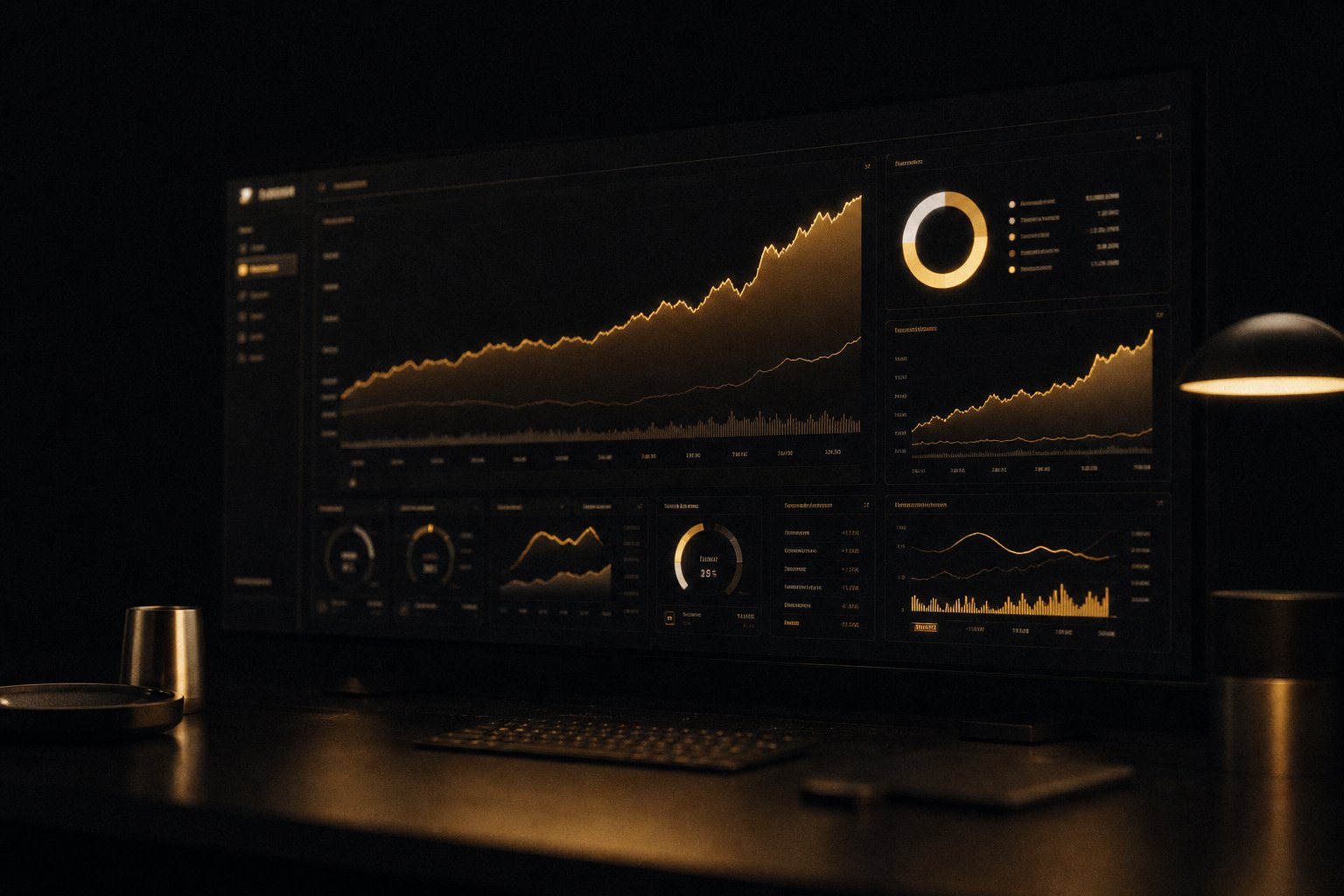
Quantum Horizon brings performance, benchmarks, risk measures, and financial definitions together. This public reconstruction uses illustrative fund and equity scenarios—not QDA’s historical performance or a connected account.

Explore the full Horizon experience
Illustrative reporting snapshot
Quantum Horizon illustrative comparisonOriginal demo fund and equity paths alongside a dashed BTC reference. Shape is illustrative; the diagram does not establish QDA returns. Full source and calculation details are available in Horizon.
  • Demo fund
  • Demo equity
  • BTC reference

Illustrative comparison. Explore Horizon for values, risk measures, and source details.

(06)The experimental lab

Interactive Reasoning & Simulations

The Lab. Try something.

Try a decision exercise, explore a financial simulation, or play a game. These are optional experiments—not gates to the résumé or project work.

Interactive Module 1 · Decision Reasoning
(A)Decision reasoning exercise

What would you do with imperfect evidence?

This fictional exercise is inspired by the questions civic research raises—not an actual organization or funding decision. Six adjustable signals illustrate how evidence changes a rule-based assessment. Toggle the evidence and watch the recommendation move.

The rule that matters: sourced facts and inferred labels never get mixed. Inference can support a decision — it just has to stay visibly marked as inference.

Scenario score

82

Source-labelled share

93%

Fictional record — classify

Recommendation

Strong score in this exercise

The selected fictional signals receive a strong score under these illustrative rules. This is not a validated probability or a real funding recommendation; retain the source labels and review the underlying evidence.

(07)The approach

Business experience. Practical AI. Care for the people using it.

I start with the work: the information people need, the decisions they make, and the steps that slow them down. Then I work out where AI can help, how it fits with existing tools, and what needs human review.

My work spans investment operations, AI-assisted civic research, workplace reference tools, and independent projects. The project pages distinguish my responsibilities, collaborators, demonstrated uses, and work still in development.

Read the full background How I approach the work
(08)Tools and working methods

Tools with a
reason to exist.

I build reusable skills and working methods for choosing AI tools, checking evidence, and keeping work on track. Each entry explains the problem it addresses, what I designed, and where it stands.

Filter tools
Read the complete tools catalog

Tool details

(09)Philosophy

What makes the work worth doing.

I want a better answer to “Why this?” than that it was technically possible or looked impressive. The people affected should count in deciding what is worth doing — not only in judging the result.

I think of AI as a sharp knife: its usefulness depends on skilled handling, appropriate limits, and care for the person affected.

/01

Useful to whom?

Making something available is one part of helping; making it usable is another.

People bring their own goals, knowledge, constraints, and preferences, and those circumstances help determine what a useful solution should be. A technically sound answer can still be difficult to understand or impractical to follow. I want the person receiving it to leave with a clearer next step and the confidence to approach it.

In practice — This principle informs requirements, source review, operating limits, and the definition of success across the projects on this site.

/02

An answer has to earn trust

A record that looks complete can still contain an unresolved assumption.

The possibilities of AI interest me, but so does the question of what justifies relying on the result. In nonprofit research I challenged questionable classifications and record matches and requested source verification. The standard I hold the work to: someone relying on it can tell what is supported from what is assumed.

In practice — This principle informs requirements, source review, operating limits, and the definition of success across the projects on this site.

/03

Finding a direction

My path was not a sequence I planned in advance.

Founding and leading an investment firm, nonprofit work, and fitness remain relevant without having to be steps in one long-term strategy. I bring those experiences to creating and improving systems: understanding the problem, connecting the right people and tools, checking what comes out, and making it easier to use.

In practice — This principle informs requirements, source review, operating limits, and the definition of success across the projects on this site.

/04

Put the idea to work

Scrutiny should lead to better decisions.

Sometimes an unresolved assumption needs more investigation. Sometimes a limited experiment is the honest next step, with clear boundaries and a clear account of what it can and cannot establish. I want to build ambitious things and stay willing to change them when someone's experience shows I solved the wrong problem.

In practice — This principle informs requirements, source review, operating limits, and the definition of success across the projects on this site.

The Living BriefAI guide and free search of Aaron’s work

Ask about Aaron’s work, decisions, or experience. Evidence first; the internet has enough confident guessing. Use the AI guide or search the same reviewed material without AI. This guide is not Aaron speaking.

A few useful places to start

0 / 600 charactersA daily AI question limit applies.

Enter to ask the AI guide · Shift+Enter for a new line.

AI questions are processed by Cloudflare. Search without AI runs in your browser. This site does not save your questions or chat history. Please don’t include private information.